
Rhenium-186 (Re-186) is a radioactive isotope of rhenium with a half-life of about 3.7 days. It decays mainly by beta-minus emission to stable osmium-186, with a smaller electron-capture branch leading to tungsten-186. Its decay also produces a characteristic gamma ray at approximately 137 keV, allowing Re-186 to be detected by gamma spectroscopy.

Re-186 is primarily used and studied in nuclear medicine for radionuclide therapy. Its beta radiation can deliver a therapeutic dose to targeted tissue, while its gamma emission allows imaging and monitoring of the isotope's distribution. Re-186 has been investigated for applications including treatment of bone metastases, radiosynovectomy, and targeted radiopharmaceutical therapy.

Re-186 does not occur naturally in significant quantities and is produced artificially. It can be generated in nuclear reactors by neutron irradiation of enriched Re-185 targets and can also be produced using particle accelerators. In practice, Re-186 is mainly encountered at isotope-production facilities, radiopharmaceutical laboratories, and nuclear medicine research or treatment centers.
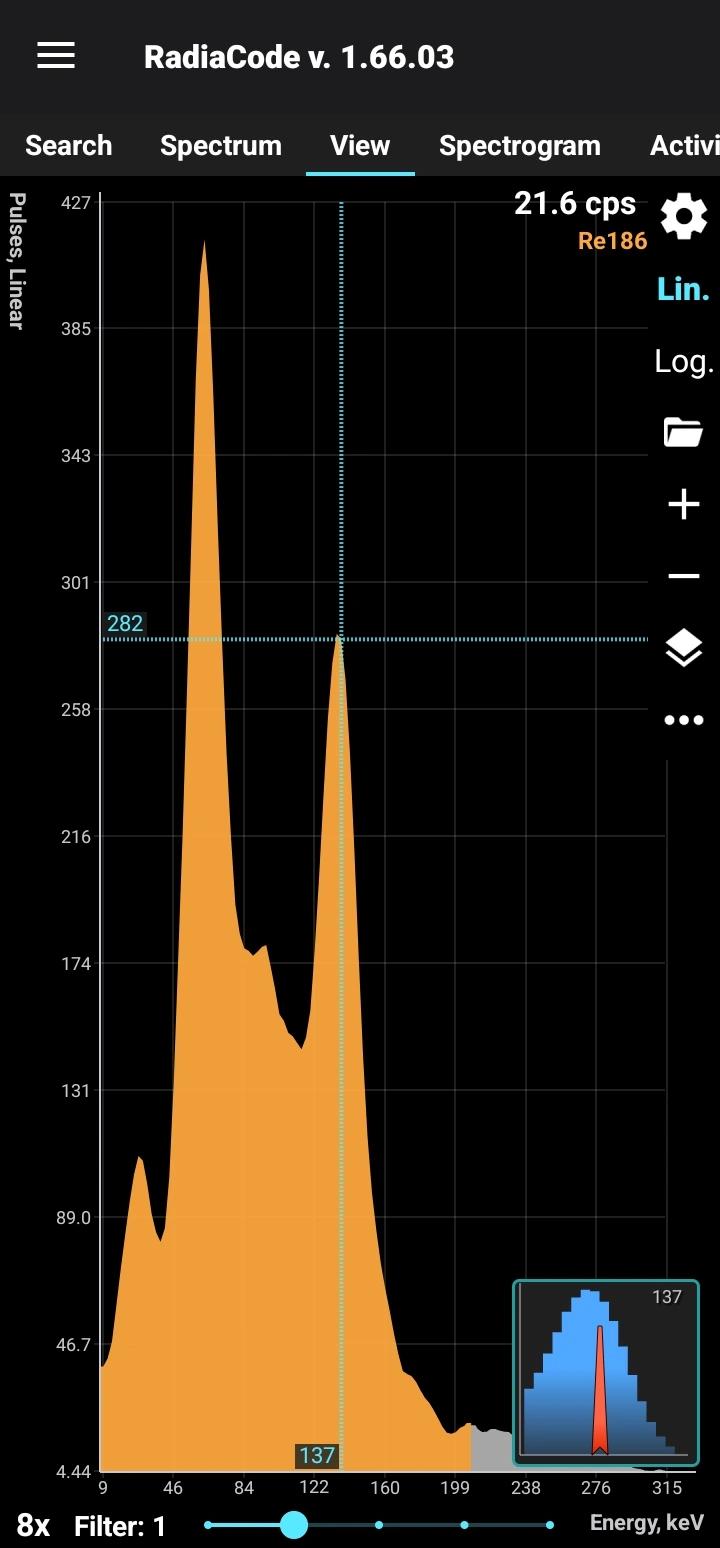
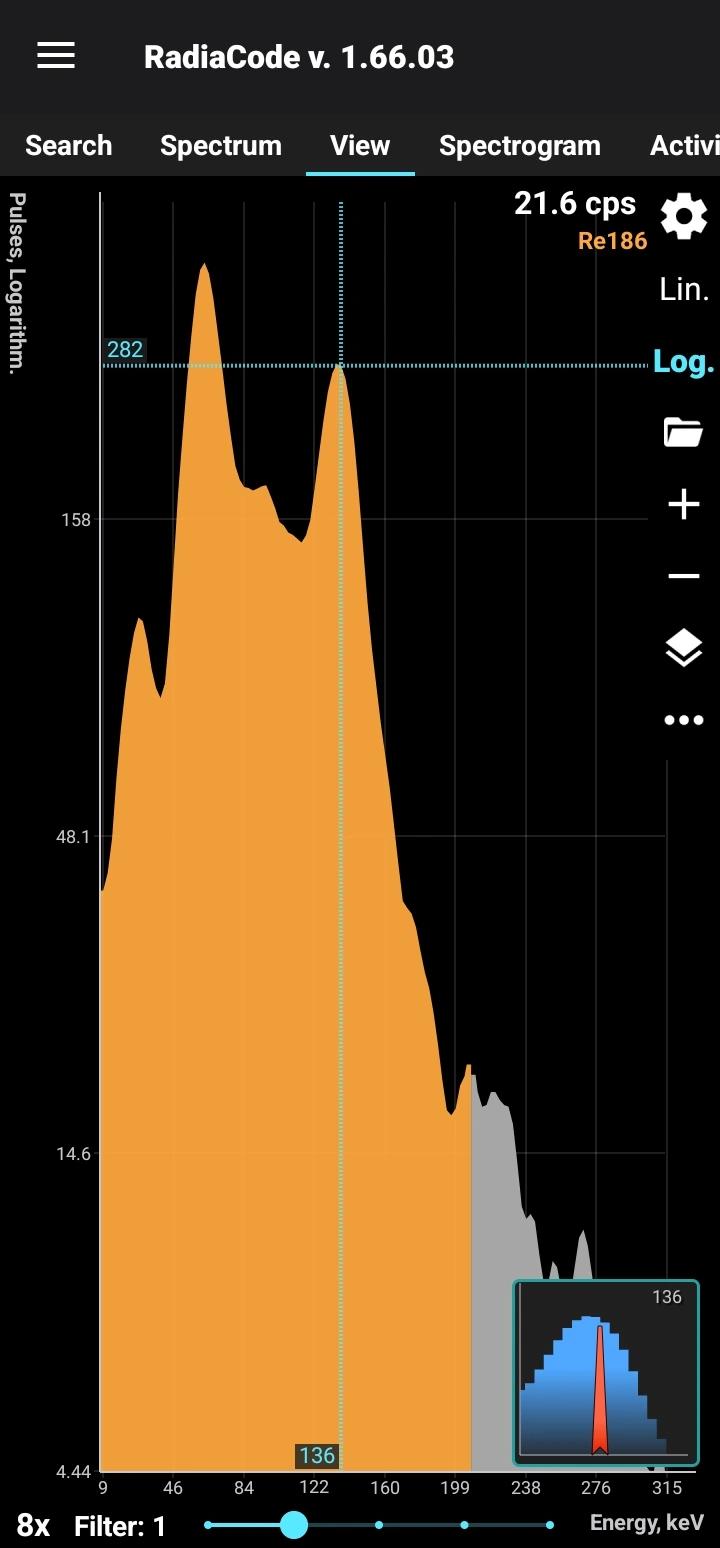
Re-186
Rhenium-186
Half-life: 3.7 days Main emission lines: 137 keV
Decay mode Beta-
Beta-
| Avg. En., keV | Intensity, % | Decay En., keV |
| 360.5 | 70.93 | (1072.7) |
| 307.4 | 21.48 | (935.5) |
Gamma
| Energy, keV | Intensity, % |
| 137.15 | 9.47 |
X-rays
| Energy, keV | Intensity, % |
| 7.822 - 12.963 | 2.9 |
| 63.000 | 1.96 |
| 61.486 | 1.14 |
| 71.079 - 73.596 | 0.84 |
| 71.079 - 71.912 | 0.66 |
| 73.325 - 73.403 | 0.183 |